Fish and Chip Compostable Boxes: Grease, Heat and Disposal Guide
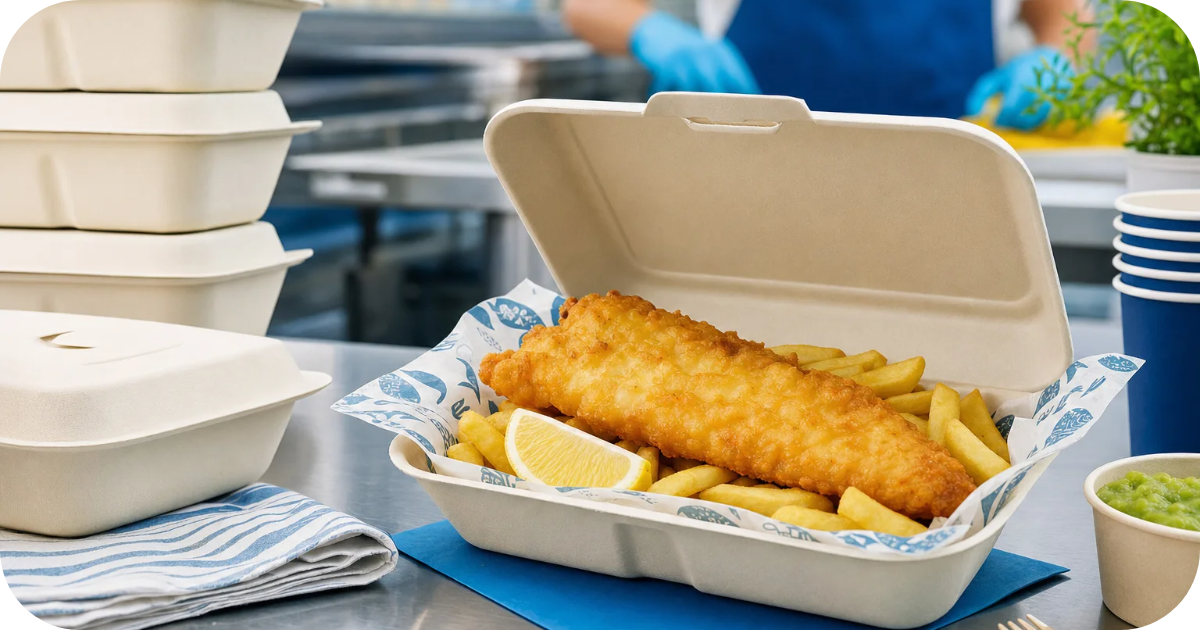
Compostable boxes for fish and chips are takeaway food containers often made from plant-based, fibre-based or compostable materials. They can break down in controlled composting conditions after use. This point matters because fried fish, chips, vinegar, salt, steam and travel time all stress the box. For example, a dry sandwich pack faces much less oil and heat.
Fish and chip shops now face pressure from customers, councils and event buyers to reduce avoidable plastic. Nevertheless, a hot portion can sit in a closed box for 10 to 20 minutes before the customer opens it. During that time, steam softens board. Oil tests the lining. Poor venting can also turn crisp batter soft.
This article explains how compostable fish and chip packaging works in real service. It covers heat, grease, steam, disposal wording, food-contact evidence and bulk buying checks. Additionally, it gives practical sizing notes for trade buyers. Those buyers need packaging that works during a busy service, not only on a product photo.
What makes boxes for fish and chips compostable?
Compostable boxes for fish and chips are classed as compostable when the box material and any coating can break down under defined composting conditions. In trade buying, the useful question is not only whether the box says compostable. Buyers also need to know whether the full pack suits hot, oily takeaway food.

A fish and chip box often uses kraft board, bagasse, moulded fibre, or coated paperboard. Kraft board is a paper-based material with a brown, natural finish. Meanwhile, bagasse comes from sugarcane fibre. Corrugated board adds a fluted middle layer. As a result, it gives more stiffness for larger meals and delivery orders.
Compostability depends on the full construction. For example, a box with a compostable board but a non-compostable plastic film may fail a composting claim. Buyers should ask whether the coating, ink and adhesive sit within the same compostability evidence as the base board.
Good to know: BS EN 13432 is the common compostability standard buyers see in the UK and Europe. It covers disintegration, biodegradation, heavy metals and plant growth effects under controlled conditions.
In a real counter service, a practical test starts before any bulk order. Place one hot fish portion and one chip portion in the box for 15 minutes. Then check the base, corners and lid. A box that looks fine when empty may flex once oil and steam collect in the folds.
Common material options for fried takeaway meals
Kraft takeaway boxes suit many hot meals because they give a clean trade look and stack well on shelves. Buyers comparing closed boxes for meals can review kraft boxes and containers when they need a practical board format for hot food service.
Open trays serve fish, chips, sausage, curry sauce pots and sides when the food gets eaten quickly. Closed boxes protect meals during collection and delivery, but they hold more steam. Consequently, that difference matters more for fried food than the colour of the board.
Printed options add brand detail, allergen prompts or disposal wording. Still, print should not sit in direct food contact unless the supplier can show suitable evidence. A plain compostable box with a printed outer sleeve can be a safer route for small branding runs.
How do compostable boxes handle fish and chips grease, heat and steam?
Compostable fish and chips boxes can cope with hot fried food and grease when the board has suitable grease resistance. The seams also need to hold under steam. Likewise, the lid needs to let moisture escape. The weakest points are usually folded corners, base panels and tight lids with no venting.

Freshly fried fish often leaves the fryer after oil temperatures of about 175°C to 190°C. The food surface cools before it enters the box. Even so, the pack faces hot oil, trapped vapour and pressure from stacked orders. Chips add moisture, especially when salt and vinegar go on before closing.
Grease resistance comes from the board treatment or lining. Some compostable linings resist oil for short takeaway journeys. In contrast, untreated board can darken and soften fast. A 10-minute counter test and a 20-minute delivery test give clearer answers than a dry sample inspection.
Steam control matters for food quality. A fully sealed lid keeps heat in, but it can soften batter and chips. Small vent gaps, a looser tuck, or a box shape with headspace can reduce condensation. In addition, these features help the meal stay warm without trapping too much steam.
The right fish and chip box manages a trade-off: it must hold heat without trapping so much steam that the food loses its bite.
For very wet toppings, such as curry sauce or mushy peas, use a separate lidded pot where possible. Sauce in the main box raises moisture and can attack the base. Side separation also helps staff pack faster during a 30-order rush.
Heat retention in compostable boxes for fish and chips
Heat retention depends on board weight, box depth, lid fit and air space. A shallow tray cools faster, but it lets steam escape. On the other hand, a deep closed box holds warmth better, although it needs venting for fried batter.
Foil containers keep heat well and suit some hot meals. Yet they do not offer the same compostable route as fibre-based boxes. Buyers can compare that use case with foil containers for hot food when heat retention matters more than compostability.
Rule of thumb: test a box for 20 minutes with the greasiest normal meal you sell. Dry chips alone will not show the same stress as fish, scraps, vinegar and sauce.
Greaseproof support for fried fish and sides
A liner or greaseproof bag can protect the main box when portions are oily. Greaseproof paper also helps staff lift fish into place without tearing the batter. For smaller sides and wrapped items, greaseproof kraft bags can support fried food service.
Operators should still avoid treating a greaseproof liner as a fix for a weak box. If the base folds collapse after 15 minutes, the box is not right for that meal. Therefore, the lining should improve service, not rescue the wrong specification.
Compostable vs Recyclable Boxes for Fish and Chips: Disposal and Performance Differences
Disposal and performance comparison for fish and chip takeaway box options
|
Box type
|
Hot food and grease performance
|
Best disposal route
|
Customer instruction
|
Evidence buyers should check
|
|
Compostable coated board
|
Good for short hot trips
|
Commercial composting
|
Compost where accepted
|
BS EN 13432, food-contact statement
|
|
Uncoated recyclable cardboard
|
Limited with oil
|
Dry recycling if clean
|
Recycle only if clean
|
Recyclability note, food-contact statement
|
|
Greasy cardboard box
|
Weakened by oil
|
General waste
|
Bin if greasy
|
Clear disposal wording
|
|
Corrugated fibre box
|
Stiffer for larger portions
|
Depends on coating and soiling
|
Follow pack label
|
Material spec, coating evidence
|
|
Printed takeaway box
|
Depends on ink and coating
|
Depends on full pack
|
Check local option
|
Ink safety, compostability scope
|
Compostable and recyclable boxes are different because they rely on different waste routes. Compostable packaging needs a composting route that accepts food-contaminated fibre packs. Recyclable cardboard needs the box to stay clean and dry enough for paper recycling.
Where greasy food changes the waste route
Fish and chips create a disposal problem because the box often carries oil, salt and food residue. Clean cardboard can enter recycling, but greasy cardboard may spoil paper recycling streams. Therefore, a recyclable claim does not help if most used boxes leave the shop stained with oil.
Compostable packaging can make more sense for greasy food if the customer has access to a suitable food waste or commercial composting stream. Yet many households cannot compost coated takeaway packaging at home. The instruction must match the real disposal route, not just the material claim.
Watch out: “Compostable” does not mean “put in any garden compost bin.” Many certified packs need industrial composting conditions, including controlled heat, moisture and time.
Customer wording should stay short. Use phrases such as “commercially compostable where accepted,” “recycle only if clean and dry,” or “dispose with general waste if greasy.” Staff can also repeat the instruction on printed stickers, till receipts or menu notes.
What disposal instructions should takeaway customers receive?
Takeaway customers should receive disposal instructions that match the material, the food residue and the local collection route. The best wording uses one clear action and one condition. Customers make the decision quickly after eating, so short wording works best.
For a compostable fish and chip box, a practical instruction is: “Commercially compostable where accepted; bin if no composting route is available.” That wording avoids a false home-compost promise. It also accepts that many takeaway meals get eaten away from home, in cars, parks or workplaces.
With recyclable cardboard, use “Recycle only if clean and dry.” If the box has oil marks or sauce residue, the customer should use general waste. This clear split helps prevent greasy board from entering paper recycling bins.
At event catering jobs, signage matters more than small print. Put matching words on bins, menus and packaging. A 3-bin layout can work well: food waste, dry recycling and general waste. Nevertheless, the packaging must match the waste contractor’s accepted list.
Example wording for shop counters and delivery orders
Chip shops can keep wording short across plain and printed boxes. A label can say “Box: commercially compostable where accepted. Food scraps: food waste. Greasy or mixed waste: general waste.” That gives staff a simple answer during a queue.
Delivery orders need even simpler wording because the customer may not see a bin sign. Add disposal text on the bag sticker or printed receipt. If you use paper carry bags for boxed meals, kraft SOS handle bags can carry a sticker with the same disposal message.
Printed fish and chip takeaway boxes can include disposal wording, a logo and a short food safety note. For low-volume branding, a plain stock box plus a printed sticker often keeps ordering flexible. For larger repeat orders, direct print can reduce handling time at the counter.
What should you check before buying compostable boxes for fish and chips in bulk?
Trade buyers should check material evidence, food-contact status, box dimensions, case quantity, order lead time and real meal performance before buying compostable boxes for fish and chips in bulk. A small sample test prevents costly mistakes across 500, 1,000 or 2,500 units.
Food-contact evidence should confirm that the packaging suits direct contact with hot, fatty food. Ask for a declaration of compliance or supplier food-contact statement. Similarly, paper and board buyers should ask about inks, coatings and adhesives. They need to know whether these parts sit outside the food contact area or meet the same safety requirements.
Compostability evidence should name the tested material and standard. If the certificate only covers raw board, it may not cover the finished printed box. Buyers should request clarity on the finished pack, especially for printed, laminated or coated options.
Bulk pricing and quantity breaks need plain comparison. Stock packaging often has lower minimums than custom printed packaging. Moreover, printed packaging may require artwork approval, plate setup or a minimum order of several hundred or several thousand units. The exact quantity depends on the supplier and print method.
Money-saver: for a new menu item, test 1 case before committing to printed stock. A portion size change can make thousands of branded boxes the wrong depth.
Sizing fish and chips compostable boxes for portions
Box size affects food quality and speed of service. A small box can crush batter, while an oversized box lets food move and lose heat. Typical takeaway boxes range from about 500 ml snack sizes to 1,000 ml or larger meal boxes. Still, dimensions matter more than volume alone.
-
Choose a shallow tray for chips, scraps and quick-eat portions.
-
Select a medium closed box for one fish and chips meal without large sides.
-
Keep a deeper box for large fish, extra chips or a meal deal.
-
Use separate pots for curry sauce, gravy, beans or mushy peas.
-
Allow headspace above battered fish to reduce lid contact and sweating.
Example: for a test run of 60 Friday meals, pack 20 standard fish suppers in a medium box, 20 large portions in a deeper box and 20 chip-only portions in trays. After 20 minutes, compare base strength, lid moisture and food movement across all 60 packs.
MOQ, lead time and delivery questions
MOQ means minimum order quantity. For stock packaging, buyers may order by the case. For custom printed packaging, order quantities and lead times vary by supplier and print method. Lead times usually start after artwork approval.
Delivery and collection questions should be clear before the order goes in. Ask whether all sizes are held in stock. Also ask whether mixed cases are possible, and whether back orders ship together or separately. Local buyers also need to know collection cut-off times and order processing days.
Thali Outlet serves trade customers through a searchable ecommerce catalogue with basket and login ordering. That setup suits buyers who reorder bags, boxes, napkins, cutlery and cleaning stock across a normal week. It also helps staff find packaging by category instead of searching through mixed product lists.
Practical recommendations for ordering compostable fish and chips boxes
Good ordering starts with the meal, not the material claim. Match the box to the hottest, oiliest and longest-held portion you sell. Then check disposal wording and evidence before placing a large order.

Use a simple process for packaging trials. Keep the test close to real service, because a quiet 11 a.m. check may not show what happens during a Friday evening queue. Include vinegar, salt, sauce pots and stacked orders if those reflect normal trade.
-
Choose 2 or 3 box sizes that match your main fish, chips and meal deal portions.
-
Pack hot food straight from normal service equipment and close each box as staff would.
-
Hold the boxes for 10, 15 and 20 minutes to copy collection and delivery waits.
-
Check the base, corners, lid moisture, grease marks and batter texture.
-
Confirm food-contact and compostability evidence before ordering full cases.
-
Write one disposal instruction for the box, bag sticker and counter sign.
Card trays and closed food boxes can both fit a fish and chip menu. Trays suit open service, loaded chips and fast turnover. Conversely, closed boxes suit collection, delivery and colder weather, but they need more care with steam control.
Cutlery and carry items should match the same service plan. If a meal needs forks, wooden or compostable cutlery can reduce conventional plastic items in the order. Buyers can pair eco boxes with compostable cutlery for event or takeaway service.
Custom print and brand presentation
Custom printing can help chip shops show a logo, opening hours, allergens or disposal text. Nonetheless, custom print should not hide weak packaging performance. A printed box that sweats badly will hurt food quality faster than a plain box with the right venting.
Useful design examples include a small logo on the lid, a “recycle if clean” line near the fold, or a QR-free reorder message for catering clients. Keep ink away from direct food contact surfaces unless the supplier confirms its suitability. For short runs, stickers on plain kraft boxes often reduce waste if artwork changes.
Wholesale fish and chips boxes should also fit storage space. A case of flat-packed boxes takes different shelf space from nested trays. Measure the shelf before ordering several cases, especially in small takeaway kitchens where dry goods, napkins and cleaning stock already compete for room.
The best choice is rarely the box with the strongest eco wording on the front. First, test the box with a real fish supper. Then check the certificate and disposal route before scaling up. Packaging has to protect the food first. Otherwise, the sustainability claim will not carry much weight with the customer, says the team at Thali Outlet.
FAQ
These common questions help trade buyers check performance, disposal and evidence before ordering.
Can boxes for fish and chips be compostable and still handle grease?
Compostable boxes for fish and chips can cope with hot fried food and grease when the board, coating and folds suit oily takeaway meals. Test the box with fish, chips, vinegar and normal holding time. A 20-minute trial will show base softening, grease marks and steam issues better than an empty sample.
How are compostable boxes different from recyclable cardboard boxes?
Compostable boxes are designed for composting routes where accepted, while recyclable cardboard boxes need to stay clean and dry enough for paper recycling. Fish and chips often leave oil on the box, so recyclable cardboard may become general waste after use. The correct route depends on contamination and local collection rules.
What disposal instructions should be given to takeaway customers?
Give customers one clear instruction with a condition. Use wording such as “commercially compostable where accepted” for certified compostable packs. For recyclable cardboard, use “recycle only if clean and dry.” If the box is greasy, wet or sauce-stained, tell customers to use general waste.
What certification or food-contact evidence should trade buyers request?
Trade buyers should request compostability evidence such as BS EN 13432 where a compostable claim is made. They should also ask for food-contact evidence for hot, fatty food. Furthermore, the evidence should cover the finished pack, including coatings, inks and adhesives where those form part of the box.
Are kraft, cardboard and corrugated boxes all suitable for fish and chips?
Kraft, cardboard and corrugated boxes can all work for fish and chips if the specification matches the meal. Kraft board gives a common takeaway look, cardboard offers standard box formats, and corrugated board adds stiffness. Grease resistance, venting and box depth decide suitability more than the material name alone.
Conclusion: choosing fish and chips compostable boxes
Compostable boxes for fish and chips make sense when they pass three checks: hot food performance, realistic disposal and clear evidence. The best trade choice holds oily food for the full collection or delivery window. It also gives customers honest disposal wording and comes with food-contact and compostability proof before bulk ordering.
For Leeds food businesses and caterers, Thali Outlet brings fish and chip packaging, tableware and cleaning essentials into one searchable trade catalogue. To compare a practical starting point for hot takeaway meals, view the plain kraft fish and chip boxes and add suitable lines to your basket.