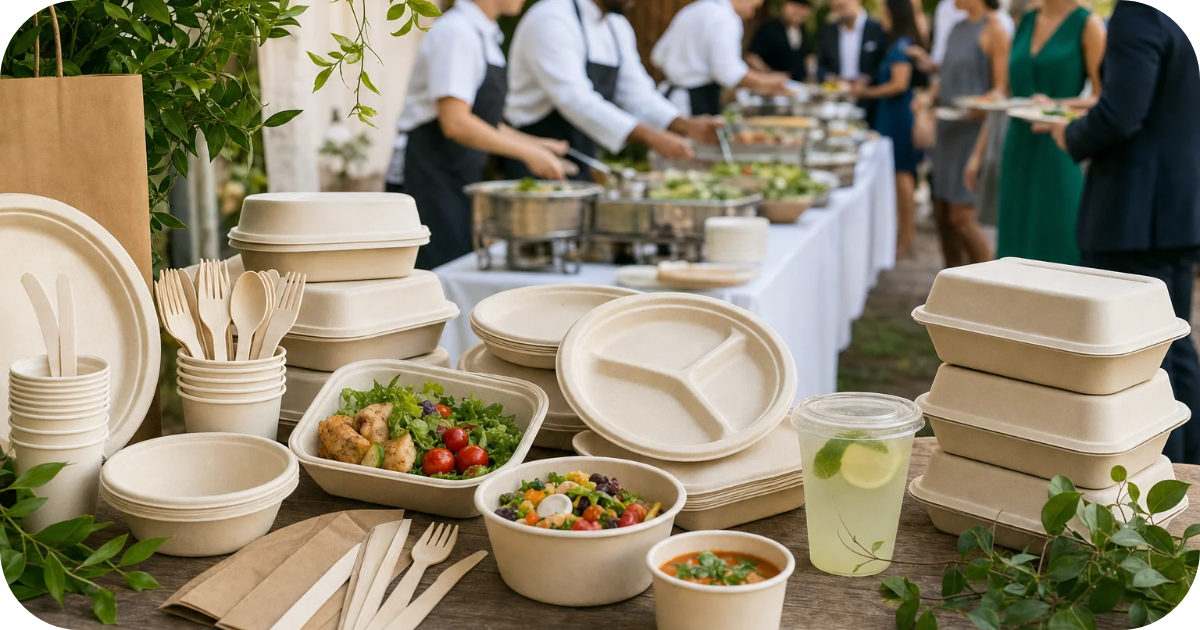
Compostable Catering Supplies for Events: Quantity Estimator and Ordering Checklist
Compostable catering supplies for events are disposable plates, bowls, cups, cutlery, napkins, trays and containers. They use plant-based or fibre materials for planned food service. A 150-guest event can easily use more than 1,000 individual disposables once drinks, seconds, desserts and staff meals are counted.
Event buyers need a clear order plan. Over-ordering ties up cash and storage, while under-ordering stops service. Additionally, compostable materials need the right food match and the right disposal route. Product choice affects performance and waste handling.
This article gives trade buyers a practical way to estimate quantities, adjust by service style, add buffer stock and prepare an order brief. It covers bulk plates, bowls, trays, cups, cutlery and napkins. In addition, it covers materials, certificates, lead times and repeat-order planning.
Estimate supplies for events: compostable catering by guest count
Per-guest estimate for core compostable catering supplies used at events
|
Item
|
Typical quantity per guest
|
When to increase
|
Ordering note
|
|
Plates
|
1.5-2.5
|
Buffets, desserts
|
Round up by case
|
|
Bowls
|
0.5-1.5
|
Soup, curry, sides
|
Match depth to menu
|
|
Cups
|
2-4
|
All-day drinks
|
Separate hot and cold
|
|
Napkins
|
2-4
|
Canapés, sauces
|
Use smaller sizes for drinks
|
|
Cutlery pieces
|
2-4
|
Multi-course meals
|
Count forks, knives, spoons
|
|
Serving trays
|
1 per 8-12 guests
|
Sharing food, buffet
|
Allow spares for reset
|
|
Takeaway containers
|
0.1-0.3
|
Grab-and-go, leftovers
|
Order lids with bases
|
For example, a per-guest estimate works best when it starts with the menu, not only the headcount. For a simple lunch, plan 1 main plate, 1 cup, 2 napkins and 2 cutlery pieces per guest. For a buffet with dessert, plan closer to 2 plates, 1 bowl, 3 napkins and 3 cutlery pieces per guest.

However, plate type matters because a dry sandwich plate does not need the same strength as a saucy curry plate. For mixed menus, buyers often choose bagasse or fibre plates for mains, and paper bowls for lighter sides or desserts. Thali Outlet lists disposable plates including paper and bagasse options for these event orders.
Rule of thumb: for a catered event with food and drinks, start with 8-12 disposable items per guest before buffer stock. The lower end suits short meetings, while the higher end suits long events with several service points.
What does each guest need for compostable catering events?
Each guest usually needs 1-3 plates or bowls, 2-4 cups, 2-4 napkins and 2-4 cutlery pieces, depending on meal length. Therefore, compostable catering supplies for events should be counted by each food and drink moment. A drinks-only reception may need no plates, while a three-part meal can use one plate for mains, one bowl for dessert and extra napkins for canapés.
A bakery presentation for 80 guests may only need 80 small plates, 160 napkins and 80 forks. In contrast, a 6-hour corporate day with breakfast, lunch and tea can need 240 cups for the same guest count if each person takes 3 drinks.
Core catering supplies for compostable events
Compostable plates cover mains, desserts, cake portions and buffet grazing. Bowls cover soup, noodles, salads, chilli, curry, porridge and desserts with sauce. For example, if the menu includes wet food, buyers should check depth, rim strength and lid fit before ordering cases.
For bowl-heavy menus, calculate one bowl for every served wet dish. If a menu has soup starter and curry main, 100 guests need 200 bowls before spare stock. Buyers can browse paper compostable bowls when starters, sides or desserts drive the order.
Drinks, napkins and cutlery supplies for compostable catering events
Moreover, cup numbers rise fast because drinks repeat more than meals. A 4-hour event with tea, water and soft drinks can use 3 cups per guest, especially when guests do not keep one cup all day. Hot drinks may need sleeves, lids or stirrers if service runs away from a fixed drinks station.
Similarly, napkins need separate planning because sizes serve different tasks. Small cocktail napkins suit drinks and canapés, while larger dinner napkins suit seated meals. For a reception, 25cm 2-ply cocktail napkins for drinks service keep the count simple.
Tip: count cutlery by piece, not by set. A 120-guest curry meal may need 120 forks and 120 spoons, but no knives.
How should catering supplies for compostable events change by service style?
Compostable catering supplies for events change by service style because guests behave differently at buffets, street food stalls and seated meals. Buffets need more plates and napkins. Street food needs stronger bowls or trays. Seated meals need cleaner place settings with fewer repeat trips.

At a buffet, guests often take a fresh plate for dessert or a second visit. Therefore, 2 plates per guest is a better starting point than 1 plate. Additionally, serving teams should allow trays or larger bowls for shared salads, breads and hot sides.
Buffets and sharing service
Buffet service needs bulk compostable plates, serving trays, napkins and spare cutlery near the line. A practical order for 100 buffet guests starts with 200 plates, 100-150 bowls if sides are wet, 300 napkins and 250-300 cutlery pieces. Add serving bowls at one per 8-12 guests when food sits on shared tables.
Large fibre or bagasse bowls work well for sharing dishes because they resist sagging better than thin paper under wet food. For buffet salads, rice or roasted vegetables, larger catering serving bowls help teams portion and refill without using mixed stock.
Street food, festivals and grab-and-go
Street food service puts pressure on leak resistance and cut resistance. Saucy noodles, loaded fries and oily food need bowls or trays that hold shape during walking service. Meanwhile, cold sandwiches and dry bakery lines can use lighter boards or kraft packs.
Festival stands should plan fast handover at 1 item per customer per visit, then add stock for repeat purchases. If a stall expects 500 transactions over 6 hours, it needs at least 500 containers, plus cutlery and napkins matched to the menu. For grab-and-go or leftovers, kraft boxes and containers keep bases and lids in one order plan.
Weddings, conferences and office catering
Weddings often use more napkins and presentation stock because courses, cake and evening food may run as separate services. A 120-guest wedding with canapés, main buffet and cake can need 240 plates, 120 bowls, 480 napkins and 360 cutlery pieces before buffer. If table covers are part of the disposable order, count tables as well as guests.
Conferences need more cups than plates because tea and water service repeats across the day. Office catering usually needs less spare stock because the headcount is tighter, yet staff meals and late additions still need cover. On the other hand, festivals need the highest buffer because sales and weather can change demand within 1 hour.
The safest event order is not the biggest order. It is the order that matches menu, service style, spare stock and disposal route.
Which spare stock percentage helps event compostable catering supplies?
A sensible spare stock allowance is 10-15% for controlled guest lists and 20-30% for open, public or multi-service events. The right buffer covers breakages, dropped items, seconds, staff meals, late guests and a small level of counting error.
For a seated meal with confirmed numbers, 10% usually protects service without filling storage with excess cases. For a buffet, 15% suits most planned events because guests may take fresh plates for second helpings. For festivals and open days, 25% gives better cover because attendance and menu demand can shift quickly.
Worked quantity example for a 120-guest event
Example: a 120-guest buffet with mains, dessert and hot drinks needs 240 plates, 120 bowls, 360 cups, 360 napkins and 360 cutlery pieces. A 15% buffer adds 36 plates, 18 bowls, 54 cups, 54 napkins and 54 cutlery pieces. The final order is 276 plates, 138 bowls, 414 cups, 414 napkins and 414 cutlery pieces.
Case rounding may push the final order above the exact estimate. If plates come in cases of 100, the 276-plate need becomes 300 plates. That extra 24 plates is useful if the venue runs a staff meal or dessert station.
Watch out: staff meals often sit outside the guest count. Add 5-10% extra food service items when chefs, servers, drivers and event staff eat on site.
Breakages, seconds and station resets
Breakage rates stay low with packed cases, but real events still lose items through drops, wet tables and fast resets. Seconds create a larger issue than breakage because one person can use 2 plates within 20 minutes at a buffet. Extra napkins also disappear quickly near sauces, coffee and children’s food.
Place spare stock by service point, not only in a back room. A 3-station buffet should split spare plates and cutlery across all 3 stations. This avoids queues while one staff member searches for another case.
What should be included in a checklist for compostable catering supplies at events?
A catering procurement checklist should cover guest count, service style, menu format, product quantities, material choice, certificates, disposal route, delivery timing and repeat-order needs. As a result, compostable catering supplies for events are easier to approve and order. A clear brief helps trade buyers place a bulk order without missing lids, napkins, table covers or back-up stock.
Use one list for the whole event rather than separate notes for food, drinks and cleaning. Mixed notes lead to missed items, especially cups, lids, stirrers, trays and waste bags. The checklist below works like a copy-and-use procurement checklist for internal approval, purchasing or download into an order brief.
Downloadable catering procurement checklist for event buyers
-
Event name, date, venue and delivery point.
-
Confirm the final guest count, staff count and expected number of food services.
-
List every menu item that needs a plate, bowl, tray, cup or container.
-
Choose materials for hot, cold, oily, saucy and dry food lines.
-
Add 10-30% buffer stock based on service control and event risk.
-
Check lids, sleeves, napkin sizes, cutlery pieces and table covers as separate lines.
-
Confirm the local waste route, including whether the venue or contractor accepts compostable items in food waste or requires another stream.
-
Ask for certificate documents when procurement or venue policy requires proof.
-
Round quantities to case or pallet units before the order is approved.
-
Mark each line as sample, case order, pallet order, repeat order or custom printed item.
Product category planning also helps buyers avoid mixed material mistakes. Put plates, bowls, trays, cups, cutlery, napkins, containers and table covers into separate lines. Then mark each line as stock, sample, repeat order or custom item.
Many event buyers need presentation stock. Table covers, large napkins and serving trays matter for weddings, award nights and client lunches. Add table covers for event service to the same checklist so the order supports the full room setup.
For bulk order support, Thali Outlet can help trade buyers turn the checklist into a practical basket by reviewing product types, case quantities, lid matches and likely spare stock. Buyers can use the order brief to ask for straightforward advice before committing to larger event quantities.
How do materials affect event supplies for compostable catering?
Material choice affects heat performance, cut resistance, leak control and disposal. Bagasse, bamboo, palm leaf and moulded fibre suit many food service jobs. Paper and kraft options work well for lighter dry food, grab-and-go packs and bakery lines.

Bagasse is fibre left after sugarcane processing, and it forms firm plates, bowls and trays. Bamboo and palm leaf options give a more rigid feel for premium service. Paperboard and kraft packs suit sandwiches, salads and takeaway. However, oily or saucy food may need lined or deeper formats.
Food performance by menu type
Hot food needs stiffness under heat, especially for curries, rice, pasta and roast meals. Cold food needs clean presentation and stack control, so lid fit may matter more than heat tolerance. Oily food and saucy dishes need leak resistance around seams, bases and corners.
Cut resistance matters when guests use knives on mains. A thin plate can flex under steak, roasted vegetables or hard pastry. For safer service, match heavier menus with fibre, bagasse or palm leaf formats rather than the lightest plate available.
Commercial composting, backyard composting and certificates
Commercial composting uses controlled heat, moisture and processing time. Backyard composting runs cooler and slower, so a product suitable for industrial composting may not break down well in a home bin. Event waste plans should follow the venue’s waste contractor, not only the product label.
Local acceptance should be checked against the buyer’s actual waste route, not assumed from the word compostable. For a Leeds venue, office, festival site or caterer, confirm whether the contracted waste collector accepts compostable packaging with food waste. Also check whether items must go to a commercial composting facility, and whether contaminated disposables will be treated as general waste. If the event is outside Leeds, repeat the same check with the local venue or council-linked commercial waste route before ordering signage, bin labels or printed claims.
Procurement teams may ask for compostability, food-contact or inspection documents. They may reference schemes or organisations such as BPI, TÜV, ASTM, FDA or SGS. These names mean different things. BPI and TÜV can relate to compostability schemes. ASTM D6400 is a compostability standard. FDA is commonly referenced for food-contact compliance. SGS can provide test or inspection documents. Buyers should keep certificate files with the event order when venue compliance is part of the contract.
Good to know: compostable does not mean every council or site accepts the item in food waste. Confirm the disposal route before printing composting claims on menus or signage.
When should buyers order supplies for compostable catering events?
Event buyers often plan to order standard stock lines 5-10 working days before the event. They can request samples 10-15 working days ahead. Custom printed or private-label items need 6-10 weeks. These planning windows can reduce risk when quantities, artwork or certificate checks need approval.
Stock orders still need time for internal sign-off, picking, packing and transport plans. Samples need extra time because the buyer may test hot food, sauces, stacking and lid fit before the final case order. Custom branding, OEM or private-label work takes longer because artwork, print proofing and production scheduling come before dispatch.
Case, pallet and repeat-order planning
Trade buyers should think in case and pallet units once the per-guest estimate is set. Cases suit single events and smaller venues, while pallets can suit caterers, large festivals and repeat hospitality programmes. Repeat orders help teams keep the same plate size, bowl depth and lid match across several events.
A simple tiered buying structure uses 3 levels: sample packs for testing, case orders for confirmed events, and pallet or repeat-order purchasing for multi-date programmes. This does not require a fixed price promise. Instead, it gives buyers a clean way to compare storage space, cash flow and stock risk before ordering.
Example tiered buying comparison for compostable event supplies
|
Buying tier
|
Unit type
|
Typical minimum order approach
|
Storage and cash flow impact
|
|
Sample pack
|
Mixed plates, bowls, cups or containers for testing
|
Small quantity for menu checks before approval
|
Low storage impact; useful before committing to cases
|
|
Case order
|
Single product line by case, such as plates, bowls or cups
|
One or more full cases rounded from the event estimate
|
Moderate storage impact; suits confirmed guest counts and single events
|
|
Pallet or repeat order
|
Multiple cases of core lines for several dates or larger attendance
|
Planned around recurring menus, stock rooms and replenishment needs
|
Higher storage impact; can reduce last-minute ordering pressure when space and demand are known
|
This example is a pricing-style comparison rather than a fixed price list. Buyers can compare each tier by unit type, minimum order, stockroom space and risk of leftover items before asking Thali Outlet for current availability and bulk order advice.
Sample kit tests before bulk orders
Samples should be tested with the actual menu, not plain water or dry snacks. A saucy curry, oily noodle dish or hot soup exposes weak seams and soft bases within minutes. Likewise, a cold salad test checks lid fit, stacking and condensation during transport.
For weddings and conferences, sample testing should include table appearance. A plate may hold food well but look too small under a main portion. For festivals, hand feel matters because guests often eat while standing or walking.
The best event orders start with the menu on one page and the waste plan on the same page. Thali Outlet would rather help a buyer reduce one product line early than see lids, napkins or staff meal stock missed on the day. Furthermore, a short sample test gives the buyer clearer notes for approval, storage and final case rounding.
FAQ
These quick answers recap how to plan compostable catering supplies for events before approval.
How many supplies are needed per guest for compostable catering events?
Plan 1.5-2.5 plates, 0.5-1.5 bowls, 2-4 cups, 2-4 napkins and 2-4 cutlery pieces per guest. Use the lower end for short meetings and the higher end for buffets, desserts, drinks service and longer events. Then add buffer stock before rounding to case quantities.
How do requirements differ for weddings, conferences, festivals and office catering?
Weddings need more presentation stock, napkins and separate items for cake or evening food. Conferences need more cups because drinks repeat through the day. Festivals need stronger bowls, trays and higher spare stock. Office catering often uses tighter counts, but staff meals and late additions still need allowance.
What buffer stock should organisers add for breakages, seconds and staff meals?
Add 10-15% for controlled guest lists and 20-30% for open events, festivals or multi-station service. Include staff meals within that planning rather than treating them as an afterthought. Buffets usually need more spare plates and napkins because guests return for seconds and use fresh items.
How early should event buyers order standard stock or custom printed items?
As a planning guide, order standard stock lines 5-10 working days before the event. Request samples 10-15 working days before final approval, especially for hot or saucy food. Plan custom printed, OEM or private-label items 6-10 weeks ahead because artwork, proofing and production checks add time.
Can compostable items handle hot, cold, oily and saucy food?
Compostable items can handle many hot, cold, oily and saucy foods when the material matches the menu. Bagasse, fibre, bamboo and palm leaf options suit heavier meals better than very light paper formats. Buyers should test the actual food in samples before ordering bulk stock.
Conclusion: planning compostable catering supplies for events
Good planning for compostable catering supplies for events starts with the guest count, but it should not stop there. Service style, menu type, material performance, certificates, disposal route, spare stock and lead time all change the final order. A 120-guest event can move from 120 plates to 276 plates once buffet service and a 15% buffer are counted, so the order brief needs clear numbers.
Build the order in trade units: samples first, then cases, then pallets or repeat orders where the event programme justifies it. Moreover, keep certificates and disposal notes with the purchasing file if a venue or client asks for proof. This approach can reduce waste, help protect service and give buyers a cleaner basket before checkout.
For a practical starting point, build the core food service count around plates, bowls, cups, napkins and cutlery, then add buffers and case rounding. If cutlery is the next line on your order, view the compostable cutlery range and match forks, knives and spoons to the menu.