We utilize essential cookies to ensure our website operates effectively and remains secure. Additionally, we'd like to request your permission to use optional cookies. These are intended to enhance your browsing experience by offering personalized content, displaying advertisements that are relevant to you, and helping us to further refine our website.
Choose "Accept all cookies" to agree to the use of both essential and optional cookies. Alternatively, select "Let me see" to customize your preferences.
Privacy Preference Centre
Our website utilizes cookies to enhance your browsing experience and to present you with content tailored to your preferences on this device and browser. Below, you will find detailed information about the function of cookies, enabling you to make informed choices about which cookies you wish to accept. Please note that disabling certain cookies might impact your user experience on our site. It's important to remember that cookie preferences need to be set individually for each device and browser you use. Clearing your browser's cache may also remove your cookie settings. You have the freedom to modify your cookie preferences at any point in the future.
For a comprehensive understanding of our use of cookies, please refer to our complete cookies policy.
These cookies are needed for the website to work and for us to fulfil our contractual obligations. This means they can't be switched off. They enable essential functionality such as security, accessibility and live chat support. They also help us to detect and prevent fraud. You can set your browser to block or alert you about these cookies, but it means some parts of the site won't work.
Performance and Analytics
These cookies allow us to measure and improve the performance of our site. They help us to know how popular pages are, and to see how visitors move around the site. If you don't allow these cookies, we won't know when you've visited our site, and we won't be able to monitor its performance.
Functional
These cookies enable us to provide enhanced functionality and personalisation. They may be set by us or by third party providers whose services we've added to our pages. If you don't allow these cookies, some or all of these services may not work properly.
Advertising
These cookies collect information about your browsing habits to show you personalised adverts. They may be used to build a profile of your interests and show you relevant adverts on other sites. They don't store directly personal information, but are based on uniquely identifying your browser and internet device. If you don't allow these cookies, the adverts you see will be less relevant.
Compostable Utensils Bulk Buying Guide for Caterers and Events
Compostable utensils bulk buying means ordering plant-based forks, knives, spoons and cutlery sets in case quantities. Caterers use them for takeaway, events and daily food service.
A busy lunch counter can hand out hundreds of forks before mid-afternoon. Meanwhile, a wedding buffet may need three utensil types for every guest. Small errors grow fast at trade scale. Therefore, compostable utensils bulk orders need more thought than a simple fork count. Buyers must match cutlery to food weight, service time, heat, waste handling and spare stock.
Local food businesses also buy a wider product mix now. Menus use bowls, kraft boxes, trays, cups, bags and napkins across the same service. As a result, utensils rarely sit alone in the basket. This guide shows how to choose cutlery for real foodservice settings. It also explains how to count stock, check strength and decide when reusable cutlery makes more sense. Keep the order practical. Match each item to the job it must do.
Match Bulk Compostable Utensils to Your Service Setting
Compostable utensil choices by catering, takeaway and event use case
Foodservice setting
Recommended utensils
Strength and heat needs
Quantity planning tip
Hot takeaway meals
Forks, knives, spoons
High stiffness, check stated hot-food rating
1 set per meal plus 10%
Buffet catering
Forks, knives, teaspoons
Medium strength, mixed foods
1.2 forks per guest
Dessert service
Teaspoons, dessert forks
Low heat, smooth edges
1 utensil per portion plus 5%
Street food events
Forks, sporks, napkin sets
Strong grip, oily foods
1.3 utensils per ticket
Office catering
Wrapped sets, stirrers
Hygiene-led, light meals
1 set per attendee plus 8%
Bakery sampling
Mini forks, taster spoons
Light strength, ambient foods
2 tasters per visitor
Plan utensils by menu type
Compostable utensils work best when buyers match each item to the service style before placing a trade order. A hot rice box needs a stronger fork than a tray of cake samples. Similarly, a buffet needs more spare forks than knives. Guests often return for a second portion. For a 100-guest buffet, many caterers plan 120 forks, 80 knives and 100 spoons. This works well when sauces, sides and desserts all appear.
Takeaway operators should start with the meal format. Curry, noodles, loaded chips and salads all place different stress on cutlery. This matters more when food sits in a delivery bag for 15 to 30 minutes. If the order also includes kraft takeaway boxes, check that the utensil length suits the container depth. A short fork can make a deep box hard to eat from.
Allow for service points and spare stock
Event buyers should also plan service points. A single buffet line for 150 guests loses more cutlery to drops and second trips than a plated service with staff control. Therefore, a 5% buffer suits controlled service. In contrast, a 10% to 15% buffer fits open public events. Use the larger buffer when guests serve themselves.
Good to know: For public events, count utensils against transactions, not headcount. A 500-person event with snacks, mains and dessert can need 800 to 1,000 individual utensils.
Materials for Bulk Compostable Utensils: Bamboo, Plant-Based and Fibre
Bamboo, PLA, fibre, bagasse and paper-based cutlery differ in feel, heat tolerance, composting route and menu fit. Compostable utensils bulk buyers should treat material choice as a strength and service decision. It is not only a green claim. A cold salad bar can use a lighter utensil. However, hot dense foods need stiffness and a clean edge.
Plant-Based Cutlery for Cold and Warm Service
Plant-based cutlery often uses materials such as PLA or CPLA. PLA suits cold foods. Meanwhile, crystallised forms can handle more warmth than standard PLA. In practical buying terms, ask whether the item suits hot food contact. Also check whether the pack states a temperature limit. The stated limit helps staff choose the right item fast.
PLA-style cutlery can feel familiar to customers because it looks similar to standard disposable plastic. Still, commercial compostability depends on the right facility. Buyers should not assume a normal waste bin gives the same result. For cafés and event sites, clear bin signs reduce sorting errors at the point of disposal. Simple signs work best.
Bamboo, Wood and Fibre for a Natural Feel
Bamboo and wooden cutlery offer a firmer, natural look for street food, grazing tables and bakery counters. These materials suit many ambient and warm foods. However, thin forks can split under heavy pressure. Buyers comparing natural options can review wooden biodegradable cutlery when they want a simple, rustic presentation.
Fibre and bagasse products come from plant fibres. They often appear across bowls, plates and trays. Bagasse plates can pair well with fibre-style utensils at catered events. The whole table setting then looks consistent. For wet foods, test whether the fork tines stay firm after 10 minutes of contact. This small test can prevent weak service.
Watch out: Biodegradable does not always mean compostable. Compostable products need a set breakdown route. By comparison, biodegradable claims can cover many timescales and conditions.
When Is Compostable Cutlery Better Than Reusable Plastic Cutlery?
Compostable cutlery is usually better for takeaway, outdoor events, mobile catering and service points where collection is hard. Reusable plastic cutlery suits controlled venues, heavier meals and events with washing or return systems. Therefore, the right choice depends on control, not only material.
For a boxed lunch drop, compostable utensils bulk ordering keeps service simple. Each meal can leave the kitchen complete. A reusable system would need collection, sorting, washing, storage and loss tracking. If 200 lunches go to 6 office floors, that return process can take more labour than the cutlery is worth.
The most sustainable cutlery choice is the one your service can collect, clean or compost correctly after the meal.
Reusable cutlery becomes stronger when the organiser controls the room. A sit-down staff meal, private venue or ticketed banquet can use stronger tableware with return bins near exits. For heavy grilled foods or firm roasts, heavy duty reusable cutlery may give a better eating experience than lighter compostable forks.
Cost also changes with reuse count. A reusable fork only pays back if it returns, washes well and lasts across enough services. In contrast, compostable cutlery keeps planning simple for one-off events, festivals, tasting stations and delivery orders. The lower labour need can be useful for short jobs.
How Should Caterers Calculate Bulk Compostable Utensils Quantities?
Caterers should calculate compostable utensils bulk quantities from menu items. They should not use guest numbers alone. A meal with a starter, main and dessert can use 2 to 3 utensils per person. Meanwhile, a single boxed lunch may need one wrapped set. Buffer stock then protects service from drops, menu changes and late guests.
List every menu item and mark whether it needs a fork, knife, spoon, teaspoon or spork.
Multiply each utensil type by the expected meals, tickets or covers for that service.
Add 5% spare stock for staff-served meals and 10% to 15% for self-service events.
Separate wrapped sets from loose utensils because hygiene and speed needs differ.
Round up to the nearest case quantity so the basket matches trade packing.
Keep one sealed backup case for repeat services when storage space allows.
Rule of thumb: for mixed buffet service, plan 1.2 forks, 0.8 knives and 1 spoon per guest before rounding up to full cases.
Worked example: a 250-guest buffet with mains and dessert needs 300 forks, 200 knives and 250 spoons by the rule above. Additionally, a 10% self-service buffer brings the order to 330 forks, 220 knives and 275 spoons before case rounding.
Bulk-packing matters because trade cases rarely match exact event numbers. A caterer who needs 330 forks may choose the next full case and carry the balance into the next job. As a result, the site reduces emergency buying and keeps stock rotation clear. It also gives staff a clear reorder point.
Bulk-Packing Checklist for Forks, Knives, Spoons and Napkin Sets
A good bulk checklist covers service count, menu style and packing format. Loose cutlery works well behind a staffed counter. Meanwhile, wrapped fork-and-napkin sets help takeaway teams pack quickly. Napkins also deserve a separate line in the order because customers may use more than one napkin with saucy street food.
Forks for mains, salads, rice bowls and cakes.
Knives for firm foods, sandwiches, pies and plated buffets.
Spoons for soups, desserts, curries and breakfast pots.
Teaspoons or stirrers for hot drinks and sampling stations.
Wrapped sets for hygiene-led takeaway, offices and travel catering.
Strength, Heat and Food-Contact Checks for Bulk Compostable Utensils
Buyers should check strength, heat rating, food-contact suitability, compostability proof and storage conditions before scaling an order. Compostable utensils bulk purchases work best after a small practical test with the actual menu. A fork that performs well with salad may fail with dense noodles or chargrilled meat.
Strength checks should be simple and repeatable. Press a fork into the firmest food on the menu. Then cut a sample portion with the knife. Next, leave a spoon in hot sauce for 5 minutes. If the utensil bends, frays, splinters or softens, choose a heavier grade. Record the result so staff can repeat the check.
Heat checks matter most for soup, curry, rice, hot drinks and oily foods. Many compostable materials work well within a stated range. However, heat and time create the real test. A 75°C sauce held for 10 minutes challenges cutlery more than quick contact with warm cake.
Food-contact safety needs proof, not slogans. Buyers should look for food-grade statements, compostability marks such as EN 13432 where relevant, batch details and specification sheets. Similarly, wholesale compostable food packaging needs the same document check for matching bowls, plates, boxes and lids. Keep these papers with the product record.
Tip: Keep one sample from each approved case with the product label. If staff report bending or heat issues later, the sample helps compare batches and reorder the correct grade.
What Should Buyers Order Alongside Bulk Compostable Utensils?
Foodservice buyers should order compostable cutlery with the packaging that holds the meal, not as a separate afterthought. Compostable catering supplies wholesale baskets often include utensils, bowls, plates, boxes, cups, trays, bags and cleaning stock. A matched order reduces gaps during prep and service.
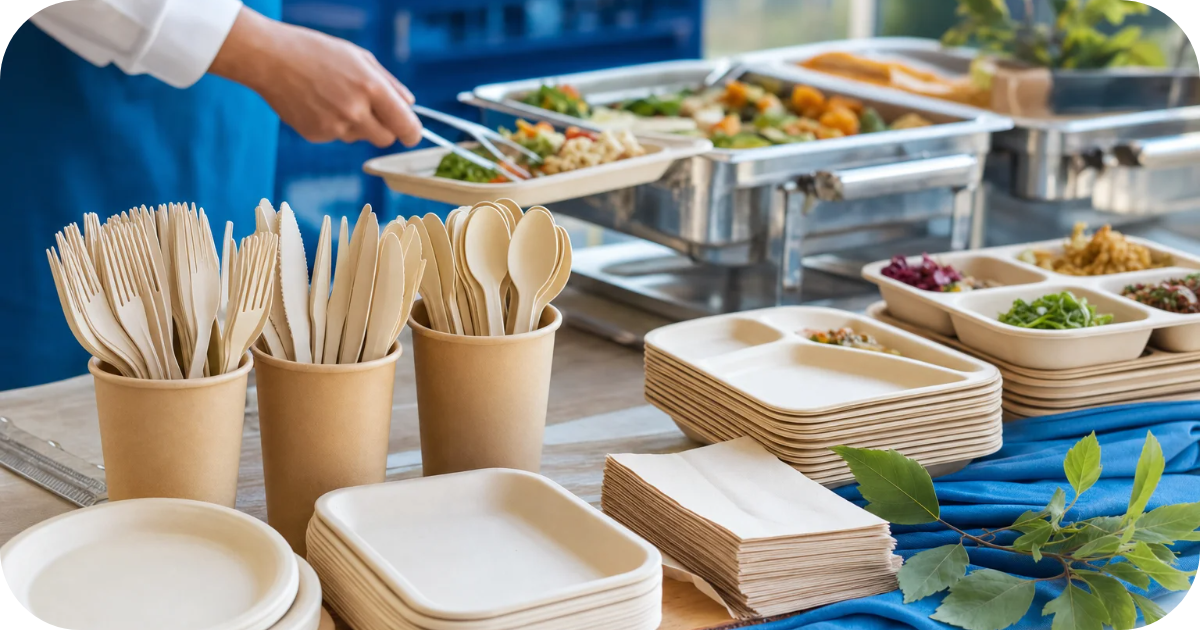
For bowl meals, pair spoons or forks with paper compostable bowls so the eating depth feels right. For buffets and events, match utensils with disposable plates for catering in sizes that suit the menu. A small dessert plate with a large knife feels wasteful. Likewise, a deep bowl with a short fork frustrates customers.
Trade buyers who buy compostable packaging wholesale should also check case storage. Compostable products often prefer dry, cool storage away from direct heat. Also, mixed stock can take more space than standard cutlery. If a site holds 4 weeks of takeaway packaging, shelving labels prevent staff from opening backup cases too early. This keeps first-in, first-out stock control easy.
Custom branding, sizing and private-label packaging may help larger operators. However, lead time and minimum order quantity change the decision. Plain stock suits urgent case orders and changing menus. Branded wraps or printed packs suit repeat volume. The setup only makes sense when the same design runs across many services. Ask for samples before a full branded run.
How Do Wholesale Bulk Compostable Utensils Orders, Samples and Lead Times Work?
Wholesale ordering works best when buyers separate regular stock from project stock. Regular stock covers weekly takeaway, café or bakery use. In contrast, project stock covers weddings, festivals, corporate catering and seasonal events. Compostable utensils bulk orders can then scale from cases to pallet-level supply without confusing daily use.
Minimum order quantities depend on the product pack and supplier setup. Case buying suits most small and mid-sized food businesses. Meanwhile, pallet or truckload purchasing fits distributors, large venues and multi-site operators. If a buyer needs custom wrapping or private-label cartons, the order usually needs more planning than a standard stock case.
Samples help prevent costly mismatches. A sensible sample check uses the real food, the real holding time and the real packing method. For example, test a spoon in hot soup, a fork in rice, and a knife on the firmest protein before approving a large order. This step is quick. It can save waste later.
Lead time also changes by order type. Stocked case orders move faster than custom print runs. Likewise, pallet orders need more warehouse planning and vehicle space. Trade customers in Leeds may benefit from local wholesale access. Urgent top-ups can be easier than waiting on a distant general marketplace platform.
Practical Recommendations for Bulk Compostable Utensils Buyers
Trade buyers should build a short approved list for compostable utensils bulk stock. Then they should review it when the menu or event format changes. The list should name the utensil type, material, pack format, matching container and disposal route. A 1-page internal list can stop staff mixing similar-looking products with different strength levels.
Start with three service groups. Use wrapped sets for takeaway and office catering. Then use loose forks and spoons for staffed counters. For hot or dense foods, choose heavier utensils. Additionally, add napkins, plates, bowls and boxes to the same purchasing plan so each meal leaves the kitchen complete.
Commercial composting needs clear handling. Compostable utensils may require an industrial composting facility, and acceptance differs by local waste contractor. If the venue cannot route waste correctly, choose the best practical option and make customer messaging honest. Do not promise composting unless the waste route supports it.
Sustainability proof should include more than broad eco-friendly language. Ask for product specifications and food-contact details. Also ask for compostability statements and any sustainability documents available for the category. For no-added-PFAS preferences, confirm the claim at product level. Do not assume it applies to every item in a range.
The best orders start with the food, not the catalogue. We would rather see a caterer test one fork with the hardest dish than buy ten cases based on appearance alone. Practical fit beats a tidy product label every time, especially during a busy service. The team at Thali Outlet
Compostable utensils bulk buying rewards buyers who connect menu, material, quantity and disposal before ordering. The strongest plan starts with use cases. Then it checks heat, stiffness, pack format and realistic buffers. For Leeds caterers, bakeries, takeaway counters and event teams, this approach can help keep service moving. It can also reduce over-ordering and product mismatch.
FAQ
Additionally, these common questions help trade buyers check quantities, materials and disposal before ordering.
Which compostable utensils are needed for different foodservice settings?
Takeaway meals often need forks, knives, spoons or wrapped sets, depending on the menu. Buffets need more forks than knives because guests return for extra portions. Dessert tables use teaspoons or dessert forks. Meanwhile, street food stalls may need sporks and napkin sets for fast hand-held service.
How strong and heat-resistant do the utensils need to be?
Compostable utensils should suit the hottest and firmest food in the service. For soups, curries and rice boxes, test the spoon or fork for 5 to 10 minutes in real serving conditions. If the utensil bends, softens or splinters, choose a heavier grade or a different material.
How should an event organiser estimate quantities?
An event organiser should count utensils by menu item and service style. A simple buffet can start at 1.2 forks, 0.8 knives and 1 spoon per guest. Add 5% for staffed service or 10% to 15% for open self-service. Then round up to full case quantities.
When should reusable cutlery be considered instead?
Reusable cutlery suits controlled settings where staff can collect, wash and store items after service. Private dining, staff meals and venue-based events often fit this model. Conversely, compostable cutlery works better for takeaway, delivery, outdoor catering and events where return rates would be hard to manage.
Is compostable the same as biodegradable for cutlery?
Compostable and biodegradable are not the same buying claim. Compostable cutlery should break down under defined composting conditions, often in commercial facilities. Biodegradable cutlery may break down over a less clear timescale. Therefore, buyers should check the product specification and disposal route before ordering at scale.
Ready to build a practical trade order? For compostable utensils bulk orders, browse compostable cutlery in bulk and match forks, knives, spoons and sets to your next service.