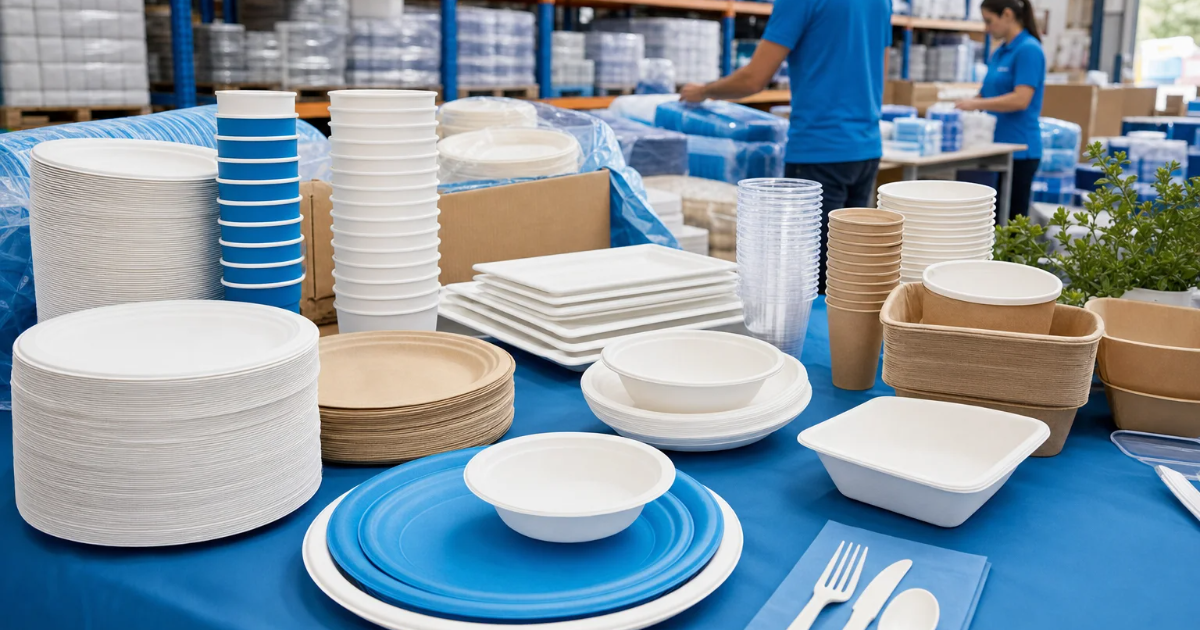
Event tableware supplies are the disposable plates, bowls, cups, cutlery, napkins and serving accessories needed to serve food and drinks cleanly at a planned event.
A 100-guest buffet can use more than 650 separate tableware items before anyone drops a fork, takes a second cup, or returns for dessert. Therefore, event tableware supplies need cost-per-guest planning, not just a quick count of plates. For caterers, bakeries, venues and community organisers, one missed case can slow service and make cleanup harder.
Planning matters more now because menus have changed. Events often mix hot food, cold drinks, desserts, takeaway portions and eco-friendly requirements in one order. Additionally, this guide shows how to estimate quantities, add spares, compare bulk case logic and choose materials before you place a trade order.
How much tableware is needed per guest for event supplies?
Most events need 2 plates, 2 to 3 cups, 1 bowl, 1 full cutlery set and 2 to 3 napkins per guest. The exact count depends on the menu, service style and drink plan. However, these figures give a safe working base for disposable tableware.

Start with the menu count
A simple lunch with sandwiches needs fewer items than a hot buffet with dessert. For example, 80 guests eating one main course and cake may need 160 plates, 80 bowls or dessert dishes, 240 cups and 240 napkins. If guests return for seconds, plate use rises first.
Plates drive the largest visible count. Use one plate for the main meal and one extra plate for dessert, bread, snacks or a fresh return to the buffet. If the event has wet, sauced or heavy food, choose stronger plates. Do not rely on extra plates to cover bending or leaks.
Allow for drinks, bowls and napkins
Cups change faster than plates because guests replace drinks often. Water, soft drinks, tea and coffee may need separate cup types. Additionally, a two-hour event with water and hot drinks often needs 3 cups per guest. A short reception may run on 1 to 2 cups.
Bowls matter when the menu includes soup, curry, pasta, fruit, salad, ice cream or plated desserts. A single bowl per guest works for one bowl-based course. However, a buffet with both starter and pudding may need 2 bowls per guest. This helps service teams keep turnover fast.
Napkins disappear quickly. Guests use them for spills, hot cups, buffet handling and cleanup. Therefore, a safe count is 2 napkins per guest for dry food and 3 to 4 for sauced, fried or finger food.
Good to know: A 100-guest event using 2 plates, 3 cups, 1 bowl, 1 cutlery set and 3 napkins needs 1,000 tableware pieces before any spare allowance.
Event Tableware Supplies Quantity and Cost per Guest Table
Quantity and cost-per-guest planning logic for common disposable event tableware categories.
|
Supply item
|
Typical quantity per guest
|
When quantity increases
|
Suggested spare allowance
|
Bulk cost-per-guest logic
|
|
Plates
|
2
|
Dessert, buffet returns
|
10% to 15%
|
Divide case cost by usable plates
|
|
Bowls
|
1
|
Soup, curry, dessert
|
10%
|
Match bowl count to courses
|
|
Cups
|
2 to 3
|
Hot drinks, long events
|
15% to 20%
|
Separate hot and cold cup cases
|
|
Cutlery
|
1 set
|
Multiple courses, cake
|
10% to 15%
|
Compare sets against single utensils
|
|
Napkins
|
2 to 3
|
Finger food, sauces
|
20%
|
Low unit cost supports larger cases
|
|
Lids and straws
|
As needed
|
Takeaway drinks, children
|
10%
|
Buy only for matching cup sizes
|
The table gives a working start for event tableware supplies and bulk case planning. It also shows why the cheapest item price can mislead buyers. A case only saves money when the size, material and count match the event and future stock use.
Rule of thumb: Plan one full eating set per guest, then add extra plates for courses and extra cups for time.
Event tableware supplies buyer guide by event size
Small events of 25 to 50 guests can often work from smaller packs if the menu is simple and there is no repeat catering need. For event tableware supplies, use the same per-guest quantities. However, avoid buying large specialist cases unless plates, cups or napkins can be carried into future jobs.
Medium events of 75 to 150 guests usually benefit from case planning. Spare allowances and buffet returns create larger totals. At this size, round core items up to full packs or cases. Additionally, keep leftovers in standard sizes that can be reused.
Large events of 200 guests or more need a service-point plan as well as a guest-count plan. Split cups, napkins and cutlery across bars, buffet lines, dessert tables and staff areas. Then add spares to each point so one station does not run out while stock is still boxed elsewhere.
What changes tableware supplies for event buffets, drinks receptions and full meal service?
Event format changes tableware quantities because guests use items in different ways. Buffets raise plate and napkin use. Drinks receptions raise cup use. Meanwhile, full meal service raises course-specific counts for plates, bowls and cutlery.
Buffet service and self-serve meals
Buffets need more plates because guests return to the serving area. A practical count is 2 to 3 plates per guest, plus 3 napkins for foods with sauce, oil or crumb. Serving tongs, trays, platters and ladles also matter because they speed up the line.
Buffet use cases include catering, restaurants, workplace lunches and community events. For hot buffet food, rigid paper, bagasse or strong plastic options often handle wet and heavy portions better than thin paper plates. Foam can help insulate hot food. However, many buyers now prefer paper or compostable materials for customer-facing service.
Drinks receptions and hot beverage stations
Drinks receptions need fewer plates but more cups. A one-hour reception can work with 1 to 2 cold cups per guest. However, a longer event with water, soft drinks and tea can need 3 to 4 cups. Hot drinks also need heat-safe cups and, in many cases, lids.
Buyers should match cup sizes to the drink plan. Small hot cups suit tea and coffee. Meanwhile, larger cold cups suit soft drinks, iced drinks and water stations. You can browse hot and cold cup options for event and catering use.
Full meal service and plated courses
Full meal service needs the cleanest quantity plan because each course may need its own item. A starter, main and dessert can need 3 plates or bowls per guest. Additionally, the count may include one fork, one knife and one spoon. If dessert needs a separate spoon, cutlery use rises by one item per guest.
Menus with rice, curry, soup, pasta or desserts often need bowls as well as plates. For these menus, browse bowls for starters, desserts and hot portions before setting the final count. Bowl depth, rim strength and lid fit can affect service more than unit price.
Good tableware planning starts with the menu, not the guest count. The guest count only becomes useful after each course has an item assigned to it.
How should event planners calculate tableware supplies spares without overbuying?
Planners should add spare tableware by risk level, not by habit. Use 10% for controlled seated meals, 15% for mixed service, and 20% for drinks, napkins or self-serve events where guests help themselves.
Build the spare count
-
Count the confirmed guests and add staff, suppliers and late additions.
-
List each course, drink station and takeaway element separately.
-
Assign plates, bowls, cups, cutlery and napkins to each service point.
-
Multiply guest count by the per-guest quantity for each item.
-
Add the spare percentage that fits the event format.
-
Round up to the nearest practical case or pack size.
A spare allowance prevents two common problems. First, it covers drops, damaged packs and last-minute guests. Second, it protects service flow when items sit at more than one station, such as a dessert table and a tea point.
Watch out: Napkins and cups need higher spares than plates because guests pick them up without asking staff. A 20% spare on cups is often safer than a second emergency trip.
Control leftovers and case rounding
Overbuying still costs money and storage space. If your venue hosts regular events, larger cases can work because unused stock carries forward. For a one-off event, smaller pack sizes may cost more per unit. However, they can reduce dead stock after the room is cleared.
Here is a worked quantity example. For 120 buffet guests, plan 2 plates, 1 bowl, 3 cups, 1 cutlery set and 3 napkins per guest. Base quantities are 240 plates, 120 bowls, 360 cups, 120 cutlery sets and 360 napkins. That gives 1,200 pieces before spares.
Add 15% spares to plates, bowls and cutlery. Then add 20% spares to cups and napkins. The final order becomes 276 plates, 138 bowls, 432 cups, 138 cutlery sets and 432 napkins. Rounded to cases or packs, the buying list should cover 1,416 usable pieces.
How does bulk buying affect cost per guest?
Bulk buying lowers the practical cost per guest when the case size matches the event. It also helps when leftover stock can be used later and the material suits the food. Cost per guest gives a clearer view than single-item pricing because each guest uses several items.
Compare the full order for event tableware supplies
To calculate cost per guest, divide the total tableware order cost by the number of guests served. For example, an illustrative order with plates at 6p each, bowls at 7p, cups at 5p, cutlery sets at 8p and napkins at 2p gives a base of 48p per guest before spares. With a 10% spare allowance, the planning figure becomes about 53p per guest.
Illustrative 120-guest comparison showing how pack choice changes practical cost per guest.
|
Buying option
|
Pack or case logic
|
Total order cost
|
Usable leftovers
|
Cost per guest
|
|
Smaller mixed packs
|
Buy closer to the rounded requirement for each item
|
£68.40
|
Low, usually under one part-pack per category
|
57p
|
|
Standard trade cases
|
Round plates, cups, cutlery and napkins up to full cases
|
£61.20
|
Moderate stock for repeat events
|
51p
|
|
Large bulk cases
|
Choose larger cases for common sizes and high-use napkins
|
£78.00
|
High, useful only if future events will use the same sizes
|
65p for this event, lower if leftovers are reused
|
This comparison is illustrative because actual pack sizes and prices vary by material, size and supplier. Therefore, the useful buying question is not only which option has the lowest unit price. It is which option gives the lowest cost per guest after realistic leftover use.
Check case quantities and leftovers
The same logic helps compare bulk disposable tableware supplies. A larger case may lower the unit cost, but the saving only matters if you can use the remaining stock. A caterer with weekly jobs can carry extra 9-inch plates. Conversely, a one-off party may prefer fewer leftovers.
Minimum order thinking also matters. Some wholesale packs come in case quantities that suit trade buyers, not small domestic events. If you need 130 forks and the best case contains far more than that, compare the total case cost. Then check how likely you are to use the surplus within future jobs.
Napkins show the strongest bulk logic because they store well and suit many menus. For planned events, bulk napkin choices can reduce repeat buying and keep service points stocked. Plates and cups need tighter size control because mismatched lids, holders or serving trays can cause waste.
Which materials work best for catering disposable tableware?
Material choice affects strength, heat use, customer feel, disposal route and cost per guest. Plastic, paper, foam and eco-friendly materials all have valid uses. However, each material suits different food types and event rules.

Paper plates and bowls suit dry snacks, cake, sandwiches and light buffet food. Bagasse, made from sugarcane fibre, gives a stronger feel for wet or heavier meals. Additionally, it often fits compostable supply policies. For buyers who need eco-friendly disposable dinnerware alternatives, paper and bagasse options often give the clearest event brief.
Plastic works well where clarity, rigidity or cold food presentation matters. Clear cups, dessert pots and lids can help display layered puddings, salads or cold drinks. However, venues with plastic limits may ask for paper, bagasse or compostable cutlery instead.
Foam can insulate hot food and drinks, but it may not fit customer or venue expectations for sustainability. Some event organisers avoid it because disposal options can be limited. If brand image matters, eco-friendly materials may justify a higher per-item cost.
-
Paper works for dry snacks, cake, sandwiches and short events.
-
Bagasse suits hot, wet or heavier portions with an eco-led brief.
-
Clear plastic helps with cold display, desserts and visible drinks.
-
Foam fits jobs where insulation and budget outweigh disposal concerns.
-
Compostable cutlery works where the venue can collect waste correctly.
Disposal instructions should be set before the event starts. Compostable items need the right waste stream, not a mixed rubbish bag. Where that route is not available, recyclable or lower-material options may give a more honest result.
For meals that need forks, knives and spoons, compostable cutlery for catered service can support a cleaner material plan. Match cutlery strength to the menu, especially for grilled meats, dense cakes and sauced meals.
What should be ordered early for urgent catering events?
Urgent catering events need early ordering for items that affect every guest, match specific sizes, or have fewer easy substitutes. Plates, cups, lids, cutlery and napkins should sit at the top of the order list. Missing one category can stop service.

For planned events, place core event tableware supplies orders 7 to 10 working days before service where possible. For local Leeds trade buyers, a cash and carry with an online basket helps reduce risk. Teams can search categories, build a list and check practical substitutes. Same-week events should focus on standard sizes first.
Lids need special care because they must match the cup or container size. Straws, stirrers, serving spoons, table covers and platters also need early checks because they sit outside the basic plate-and-cup count. Additionally, these small accessories often cause the longest setup delays.
Restaurants and caterers should also keep a starter stock for repeat jobs. Furthermore, a useful starter kit includes 9-inch plates, dessert plates, 8oz or 12oz hot cups, cold cups, forks, knives, spoons, napkins and a small range of lids. Bakeries may add cake boards, presentation trays and bags to the same stock plan.
Money-saver: Standardise 2 or 3 cup sizes across events so lids and sleeves fit more orders. Fewer size variants reduce leftover stock and picking errors.
Practical recommendations for tableware event supplies buyers
Event tableware supplies buyers should build the order from guest actions: eating, drinking, returning to the buffet, taking dessert and clearing waste. This method gives a stronger order than copying last year’s list without checking the menu.
Start with the food format. Hot mains need stronger plates and often bowls. Cold buffets need more napkins and serving accessories. Meanwhile, drink-led events need more cups, lids and waste bins than many organisers expect.
Next, choose the finish and presentation level. White paper suits simple service. Natural bagasse suits eco-led foodservice. Additionally, coloured or premium finishes suit weddings, formal dinners and brand events. Similarly, shape also matters; round plates stack fast, while compartment trays help portion curries, rice, salads and sauces.
For plated Indian, Asian or mixed hot meals, compartment trays can reduce the need for separate plates and bowls. You can browse multi-compartment trays for catered meals, which can simplify service where several dishes sit on one base. That can lower item count even when the tray costs more than a basic plate.
Sample packs can help before a large wholesale order. Check whether the plate bends under a wet meal, whether the bowl holds sauce, and whether the cup feels safe when filled. A 5-minute test with real menu food can prevent waste across hundreds of guests.
Additionally, the best event orders come from walking through the service from guest arrival to cleanup. We would rather reduce one low-risk item than under-order cups, napkins or lids, because those shortages show up in front of guests. That practical view comes from serving trade buyers who need the order to work on the day, the team at Thali Outlet.
FAQ
These answers cover the common checks buyers make before ordering event tableware supplies in bulk.
How many plates, cups, bowls, utensils and napkins are needed per guest?
Plan 2 plates, 2 to 3 cups, 1 bowl, 1 cutlery set and 2 to 3 napkins per guest for a typical event. Increase cups for long drinks service, bowls for soup or dessert, and napkins for finger food. Add a spare allowance before rounding to packs or cases.
How do quantities change by event format and menu type?
Buffets need more plates and napkins because guests return for extra food. Drinks receptions need more cups and fewer bowls. Full meal service needs one item per course, so a starter, main and dessert can require 3 plate or bowl items per guest before spares.
What spare allowance should organisers include?
Use 10% spares for seated meals with staff control, 15% for mixed buffet service, and 20% for cups or napkins at self-serve stations. Higher spares make sense where guests pick up items freely or where staff cannot restock during service.
How can bulk cases reduce the practical cost per guest?
Bulk cases reduce cost per guest when the lower unit cost outweighs leftover stock. Divide the full tableware order cost by guest count, not by product category alone. If a caterer can use surplus plates, cups or napkins later, the case saving becomes more useful.
Can tableware supplies for events include lids, straws and serving accessories?
Yes, event tableware supplies often include lids, straws, stirrers, serving spoons, platters, table covers and takeaway accessories. Add these items after the main guest count because they depend on drink stations, takeaway service, buffet layout and food safety needs.
Conclusion: planning tableware supplies for events by cost per guest
The strongest event tableware supplies plan starts with the menu, adds quantities by guest action, and checks bulk cases against real use. Plates, bowls, cups, cutlery and napkins each behave differently, so one flat multiplier will not protect every event.
Cost per guest gives trade buyers a cleaner buying method. It shows how a case price affects the full event, where spares add value, and when a smaller pack prevents waste. For Leeds caterers, bakeries, restaurants and event teams, that means faster ordering and fewer service-day gaps.
If you are building a tableware order, start with the plate count and work across the meal from there. Browse paper and bagasse plate options for mains, sides and desserts, then add cups, cutlery and napkins to match the service plan.