PP and PET Deli Containers: Material Comparison for Trade Buyers
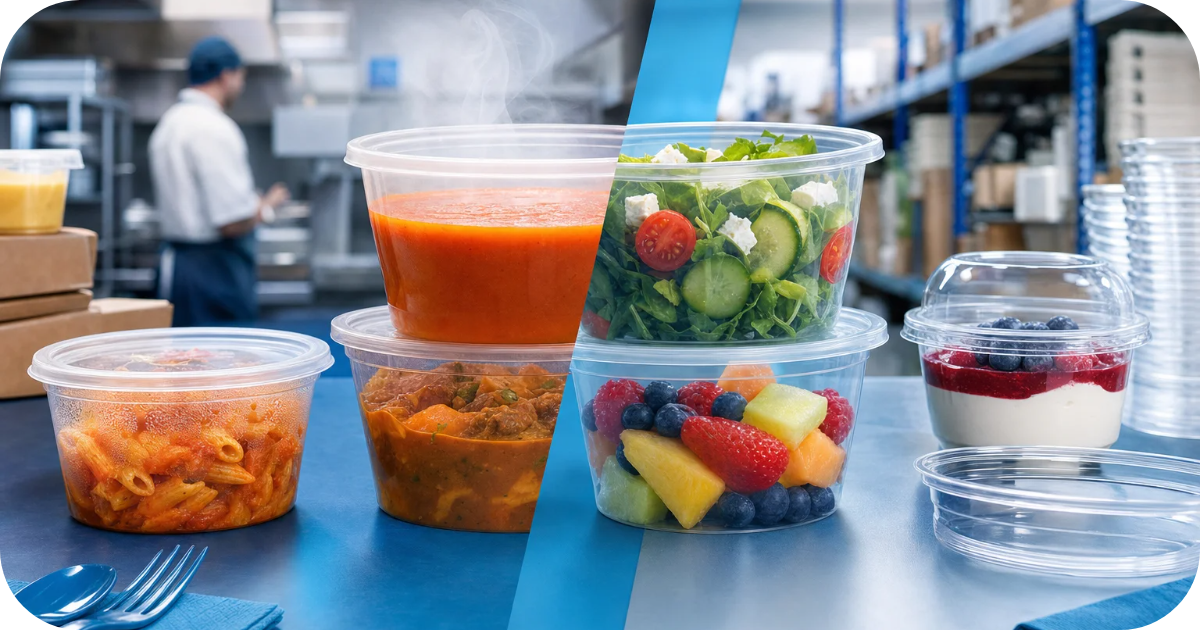
PP and PET deli containers are food-contact plastic pots for sauces, dips, samples, salads, desserts, and takeaway portions. However, each material suits different heat, display, and storage needs.
A 2oz pot is often treated as about 59ml when suppliers use US fluid ounces. However, many buyers also see similar small cups listed as 50ml to 60ml. Even so, that small naming gap matters. Portion cost, lid fit, stacking height, and sauce yield can all change during a busy service. For food businesses in Leeds, the material choice also affects microwave use, chilled display, and delivery handling.
This article compares PP and PET deli containers for practical trade buying. For example, you will learn where each material works best. Additionally, you will see which UK food-contact and recycling checks matter. You will also see when another container type makes more sense. This keeps ordering clear for busy kitchens, counters, and event teams.
PP and PET Deli Containers: Practical Differences
Side-by-side comparison of PP and PET deli containers for food service buying decisions
|
Factor
|
PP Deli Containers
|
PET Deli Containers
|
Best Choice
|
|
Clarity
|
Translucent to semi-clear
|
Very clear
|
PET
|
|
Heat suitability
|
Better for warm food
|
Usually cold food
|
PP
|
|
Microwave use
|
Often suitable if marked
|
Usually not for microwave
|
PP
|
|
Refrigeration
|
Good
|
Excellent
|
PET
|
|
Freezer suitability
|
Check product marking
|
Check product marking
|
Tie
|
|
Rigidity
|
Slightly flexible
|
Stiffer feel
|
PET
|
|
Lid security
|
Depends on matching size
|
Depends on matching size
|
Tie
|
|
Best examples
|
Hot sauce, meal prep
|
Salad, dessert, samples
|
Use case decides
|
|
Recycling notes
|
Widely collected in some streams
|
Widely recognised plastic type
|
Local rules decide
|
What is the difference between deli containers made from PP and PET?
PP and PET differ mainly in heat response, clarity, stiffness, and typical food use. In short, PP means polypropylene. This plastic has better heat tolerance. PET means polyethylene terephthalate. This clear plastic often suits chilled foods and display packs.

Polypropylene has strong heat tolerance compared with PET. As a result, manufacturers often use it for microwave-marked food tubs and hot-fill items. Standard PET deli packaging can soften at lower service temperatures. Therefore, it suits chilled service better. Hot curry sauce, gravy, or meal prep portions usually point toward PP rather than PET.
In addition, PET works best when the customer needs fast visual checks. Clear plastic visibility helps staff identify garlic mayo, chilli dip, hummus, or dessert samples without opening many lids during service. In a bakery counter, that clarity can reduce handling and keep the display neat.
Good to know: If the supplier uses US fluid ounces, a 2oz capacity equals about 59.1ml. Therefore, 50ml plastic cups and 2 oz clear plastic cups are close but not identical. Across 500 portions, a 9.1ml gap equals 4.55 litres of product.
Heat checks for deli containers in PP and PET
Microwave use depends on the material and the product marking. It does not depend on colour alone. PP containers can be microwave-safe when the pack states that use. Meanwhile, most standard PET deli containers should stay out of microwaves. Likewise, a black tub can still need a microwave symbol. Buyers should check each line before ordering.
For example, a takeaway selling hot rice bowls might pack sauce in PP pots and main meals in microwave-safe black food containers. That split keeps hot handling simple. Moreover, it avoids using a display-first material for a heat-first task. As a result, staff can explain reheating instructions more clearly.
Clarity, stiffness and quick product identification
PET usually looks clearer and feels stiffer than PP at the same wall thickness. That makes PET useful for chilled salads, fruit pots, tasting portions, and clear sample cups. Similarly, a caterer running a lunch buffet can spot dressing types quickly if each pot shows the contents from the side.
By contrast, PP has a more flexible feel. This can help when staff press on a lid or stack takeaway bags. Yet flexibility can look less premium in a chilled display. For front-of-house presentation, PET often gives the stronger first impression. The contents look brighter, and staff can check them faster.
Choose the container around the food’s handling conditions first; presentation only helps if the pack survives the service route.
Which deli containers in PP and PET suit hot sauces, chilled samples and display?
PP is usually the better choice for hot sauces and microwave-related use. PET is usually better for chilled samples and clear display. The best deli container depends on temperature, fill point, transport time, and whether the customer must see the food before opening it.

Hot sauces create three practical risks: heat distortion, lid lift, and condensation. PP handles warm fills better. Nevertheless, buyers still need to follow the product’s stated limits. For a hot takeaway counter, a 2 oz portion container made from PP can work well for gravy, curry sauce, or melted butter portions.
Chilled samples have different needs. Meanwhile, PET works well where staff serve coleslaw, salsa, diced fruit, olives, or dessert toppings from a cold counter. Because PET offers strong clarity, it helps customers tell similar colours apart. For example, staff can tell vanilla yoghurt from garlic dip without opening the pot.
Hot sauces, dips and condiments
Small portions control cost and reduce waste. If a kitchen serves 200 meals with 2 sauces each, it needs 400 lidded pots before spare stock. Add 10% service cover. The working need then becomes 440 pots for that sitting.
That same calculation helps compare 50ml cups with 60ml cups. At 400 portions, a 50ml fill uses 20 litres. In contrast, a 60ml fill uses 24 litres. The 4-litre difference can equal a full prep tub in many kitchens.
Rule of thumb: For sauces and dressings, multiply covers by portions per cover. Then add 10% spare stock for drops, lid faults, and last-minute menu changes.
Chilled samples, salads and display packs
PET suits chilled use when the food needs to sell by sight. Caterers often use clear packs for picnic salads, tasting events, dessert shots, and counter samples. In these cases, 2oz plastic shot glasses or a 2oz tumbler may look right. Still, buyers should check whether the product is food-contact suitable and lidded.
For salads, fruit and chilled deli products, buyers may compare PET-style clear hinged packs with separate deli pots. The clear salad container format can work better for larger portions because the lid stays attached. Separate pots suit sauces, tasters, and sides better. Staff can fill them in batches, then stack them neatly.
What should UK buyers check for deli containers in PP and PET?
UK trade buyers should check three basics. The container must suit direct food contact. It must also match compatible lids and show clear recycling information. Additionally, buyers should check microwave, freezer, and refrigeration symbols. Material names alone do not prove safe use.
Food-contact plastic means the material can touch food under stated conditions. In the UK, food-contact packaging sits under retained food contact rules and UK enforcement requirements. The key buyer action stays practical. Check the item is sold for food use, then follow its temperature and handling guidance.
Recycling needs a separate check. PP is often marked as plastic 5. PET is often marked as plastic 1. However, local collection, food residue, black pigment, and mixed-material lids can affect recycling. A used pack only helps if it enters the right waste stream.
Watch out: A recyclable material does not make a dirty used pot recyclable in practice. Sauces, oils, and dairy residue can cause rejection unless the waste stream accepts contaminated food packaging.
Food-contact markings and lid compatibility
Do not guess food-grade plastic suitability from appearance. Clear, black, and translucent packs can all look similar across suppliers. Buyers should check the product description, pack markings, or direct supply information before placing a trade order.
Lid fit also needs close attention. A 2oz pot from one range may not accept a lid from another range, even if both use similar capacity wording. Matching lids reduce spills during takeaway transport. In addition, tight stacking helps prevent leaning towers in prep fridges.
Round compact dimensions help small pots stack in rows and trays. Yet diameter and rim profile matter more than capacity alone. A lid that clicks firmly on a 50ml plastic cup may not seal on a different 60ml pot with a wider rim.
Recycling, compostable options and non-plastic alternatives
Recyclable, reusable, and compostable are different claims. Recyclable packaging needs a suitable collection route. Reusable packs need washing control. Compostable packaging needs the right composting stream. Since each route has limits, buyers should match packaging to the actual waste setup at the venue.
For events with food-waste collection, compostable packaging options may support a cleaner back-of-house waste plan. For oily sauces or high-visibility chilled products, plastic may still perform better. The better choice depends on the full route from filling to disposal.
How do reusable, disposable and recyclable deli containers in PP and PET compare?
Reusable containers suit closed-loop service. Disposable containers suit high-speed takeaway. Recyclable containers suit sites with clear waste routes. No option wins every case. Labour, hygiene control, customer habits, and disposal access vary across food service settings.
Reusable packs work best where the business keeps control of the item. A staff canteen, prep kitchen, or returnable lunch scheme can wash and track containers after each use. Yet reusable packs can fail in open takeaway settings because many customers never return them.
For catering, picnics, tastings, office lunches, and delivery orders, disposable PP or PET pots work well. They save washing time and allow fast portioning before service. The trade-off is waste volume. Therefore, buyers need sensible pack sizes and clear internal sorting.
Recycling-ready containers can make sense where staff can keep plastic types separate. For instance, a chilled event counter using clean PET dessert pots may collect a more consistent waste stream than a hot sauce station with oily PP pots. A workplace pantry can also set up labelled bins because repeat users follow the same routine.
How should trade buyers order deli containers in PP and PET?
Trade buyers should order by food temperature, portion size, lid match, storage space, and waste route. A short buying process prevents two common mistakes. One is choosing a clear PET pot for heat. The other is ordering lids that fit a different rim.
Ordering checklist
-
List each food by serving temperature, such as hot, chilled, frozen, or ambient.
-
Set the fill size in millilitres, and treat 2oz as about 59ml unless the supplier states a different capacity.
-
Choose PP for microwave-marked hot use or PET for chilled clear display.
-
Match lids from the same range, size, and rim type before ordering bulk packs.
-
Check stack height against fridge trays, prep shelves, and delivery bag depth.
-
Confirm the waste route, including recycling, general waste, or compostable collection.
Bulk packs, stock and ordering details
Example: A caterer serving 120 picnic boxes with 1 salsa, 1 dressing, and 1 dessert topping needs 360 filled pots. Adding 10% spare stock brings the order plan to 396 pots, so a 400-pack covers the service.
Bulk pack quantities and per-unit pricing affect real cost. A case of 1,000 pots often lowers handling time compared with five smaller packs. Even so, it also needs dry storage space. A bakery with limited shelving may prefer smaller repeat orders. An event caterer may favour larger case quantities before a weekend run.
Trade buyers should also look for clear stock and delivery information before choosing a container range. Clear availability, pack quantity, order status, and delivery or collection details help kitchens avoid last-minute material changes. If a preferred PP or PET pot is low in stock, check matching lids and suitable alternatives before the menu depends on that format.
Thali Outlet supports trade buyers who want to compare container types, add items to a basket, and order through a searchable catalogue. After choosing the material, buyers can browse hot and cold takeaway packaging for main meal packs, bags, lids, and related service items.
Practical recommendations for deli containers in PP and PET
Food businesses should stock more than one container material when menus mix hot, chilled, and display-led items. A single pot range may look tidy on a shelf. Still, it can fail if it handles the wrong temperature or transport task.

Match the material to the service job
Use PP for warm sauces, microwave-marked meal prep, and back-of-house portions that need flex during handling. Use PET for chilled foods, clear samples, desserts, salads, and quick content identification. For kraft presentation or plastic reduction, compare paper-based packs for dry, chilled, or sauced foods that suit lined board.
Portion control deserves special attention. A sauce station using 50 ml plastic cups rather than 60ml cups saves 10ml per serving. Across 300 servings, that equals 3 litres less sauce prepared, stored, carried, and discarded if unused.
Check lids, formats and alternatives
Some buyers also need tamper-evident packs, especially for delivery or grab-and-go fridges. Tamper-evident lids can reduce interference concerns. Still, they may cost more and slow down packing. For direct counter service, a secure standard lid may be enough if staff hand the food to the customer.
Money-saver: Standardise rim sizes where possible. Fewer lid types reduce picking errors, and one wrong lid case can stop a full prep run.
Kraft alternatives can work well when the food does not need crystal-clear display. For deli meals, rice boxes, and sides, kraft rectangle deli containers offer a different presentation style. They also help buyers avoid using clear plastic where the customer does not need to see the product.
The best order is rarely the one with the lowest unit cost alone. Choose the pack that protects the food. Check that the lid fits every time. Then make sure staff can keep moving during service. Small packing errors become big delays when a queue forms, especially during lunch or event service.
FAQ
These quick answers cover common trade questions about material choice, capacity, lids, and waste routes.
What are the practical differences between PP and PET containers?
PP containers handle heat better and often suit microwave-marked hot food applications. PET containers give clearer visibility and a stiffer feel. Therefore, they suit chilled salads, desserts, and display samples. Both can be food-contact plastics, but the product marking must match the planned use.
Which material is better for microwave use, refrigeration or clear product visibility?
PP is the better starting point for microwave use, provided the container is marked as microwave-safe. PET is better for refrigeration and clear product visibility because it shows contents sharply. For freezer use, check the individual product marking rather than relying on material alone.
What food-contact and recycling information should a UK trade buyer check?
A UK trade buyer should check direct food-contact suitability, temperature limits, microwave or freezer symbols, lid compatibility, and recycling marks. PP is often marked 5, while PET is often marked 1. Local waste rules and food residue still decide the real recycling outcome.
When are reusable, disposable or recyclable containers the better choice?
Reusable containers work best in closed systems where staff can collect, wash, and control them. For takeaway, disposable containers suit fast service, catering, picnics, and one-way delivery. Recyclable containers suit sites with clear waste sorting and a collection route that accepts the plastic type used.
Are 2oz pots the same as 50ml plastic cups?
A 2oz pot is not exactly the same as a 50ml cup. Two US fluid ounces equal about 59.1ml, while 50ml is a smaller metric measure. Suppliers may also use rounded capacity descriptions. Therefore, the product specification matters for portion costing across hundreds of sauces, dips, samples, or condiments.
Conclusion: choose the right material for deli containers
PP and PET deli containers serve different jobs, so buyers should start with the food rather than the shelf label. PP fits heat-led use better, while PET fits chilled display and fast visual identification. Lid match, food-contact suitability, waste route, and pack quantity then decide the final order.
The strongest buying setup uses PP, PET, and selected alternatives where each one makes sense. A hot sauce pot, a chilled sample cup, and a kraft meal box do not need the same material. Clear category choices help kitchens work faster and reduce avoidable stock errors.
To compare sizes, materials, and lidded formats for trade use, browse the food container range and add suitable items to your basket. Thali Outlet keeps the choice practical for takeaway counters, caterers, bakeries, and event supply buyers.